By Dr Michaela Giebelhausen
 |
| Eleanor Crook, Think back to partings which one had long since seen coming (2014) |
The Old Big Schoolgallery at Tonbridge School opened its doors to the public in January this year. It is run as a not-for-profit space that showcases work by established and emerging artists. It also aims to provide a forum for work produced by the school's students and staff. The handsome Victorian school room with its pointed windows and decorative roof beams has been transformed into a contemporary gallery. Along the white-washed walls runs a discreet picture rail and high-tec track lighting floats from the ceiling. At the far end of the gallery a mezzanine level has been inserted. A number of solid partitions can be locked into different positions to subdivide the large room, making this an elegant and versatile display space that blends charming architectural character with a subtle white cube flair.
Emily Glass, the curator at OBS Gallery, put together an ambitious and thought-provoking inaugural exhibition, which presented an impressive array of works by established artists such as Henry Moore, Cornelia Parker, Tracey Emin and Chris Ofili alongside works by recent art school graduates, former students of Tonbridge School and current staff (download the exhibition catalogue here).
In the Flesh explored the body and its representation whilst also inviting reflection on the materiality of the work itself. The focus was on the figure, whether human, animal or spiritual, imagined or real, representational or abstract, portrait or specimen.
The representation of the human figure is quite often a play on the portrait. A number of works in the show stretched the notion of portraiture. In Susan Aldworth's lithograph Reassembling the Self (2012) we encounter the human figure distorted and fragmented by the experience of schizophrenia in what the artist called an anti-portrait. Charlotte Chisholm reworked her own childhood self in Ghost (2014), a photograph she took during a screening of a home movie made by her parents. The former cavorting self is now arrested, and in it stillness paradoxically attests to the passage of time.
 |
| Susan Aldworth Reassembling the Self 5 (2012) |
The representation of the human figure is quite often a play on the portrait. A number of works in the show stretched the notion of portraiture. In Susan Aldworth's lithograph Reassembling the Self (2012) we encounter the human figure distorted and fragmented by the experience of schizophrenia in what the artist called an anti-portrait. Charlotte Chisholm reworked her own childhood self in Ghost (2014), a photograph she took during a screening of a home movie made by her parents. The former cavorting self is now arrested, and in it stillness paradoxically attests to the passage of time.
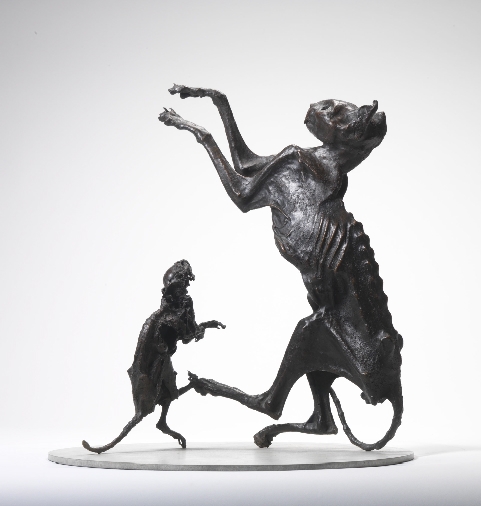 |
| Steve Dilworth's Dance of Death (2007) |
In A complete failure of the electrical impulses which keep the heart beating (2013), Thomas Parkhouse engages in portraiture of a different kind: he has cast in clay objects designed to be worn. The recast garments speak poignantly of the absent wearer. In casting unstable materials such as leather and cloth Parkhouse implicitly draws attention to the ephemerality and fragility of the body that inhabits the garment and that has shaped its folds and creases. Similarly, Steve Dilworth's Dance of Death (2007) casts the dessicated bodies of a rat and a cat, both dead from arsenic poison and grotesquely stood upright, in the smooth and stable materiality of bronze. Cornelia Parker perhaps offers the most radical transformation of material in Bullet Drawing (2009). Here the bullet's determined and lethal trajectory is spun into a delicate filament that is bent into an uneven grid.
And don't forget to set your compass to East by South East and explore the Old Big School's upcoming exhibition which will feature work by some of the most fascinating and innovative artists from China, Tibet and Japan: http://www.tonbridge-school.co.uk/about-the-school/our-facilities/obs-gallery/east-by-south-east/

