Showing posts with label Exhibition. Show all posts

Thursday, 21 August 2014

New Member of Staff: Gavin Grindon

We are pleased to announce that Gavin Grindon will be joining the staff here at Art History at Essex, starting in September. 

Gavin will join the University in September as Lecturer in Contemporary Art and Curating.   Grindon holds a PhD from the University of Manchester (“Carnival against Capital: The Theory of Revolution as Festival”) as well as an MA in Cultural Criticism (Manchester) and a BA in English Literature (Leeds).
 
Gavin recently co-curated the highly successful exhibition Disobedient Objects at the Victoria and Albert Museum, London.
  

For further information on his research, see his website, and follow him on Twitter.

Thursday, 3 July 2014

Exhibition Spotlight: Radical Geometry at the RA

By Suzanne Nolan

Radical Geometry: Modern Art of South America from the Patricia Phelps de Cisneros Collection opens at the Royal Academy on the 5th of July, and runs until the 28th of September. The exhibition

"spans a dynamic periods of South America art, charting the emergence of several distinct artistic movements in the cities of Montevideo (Uruguay), Buenos Aires (Argentina), Sao Paulo (Brazil), Rio de Janeiro (Brazil) and Caracas (Venezuela), from the 1930s to 1970s."

In addition, the exhibition is co-curated by two of the Art History department's alumni, Dr. Adrian Locke and Gabriel Perez-Barreiro, which makes it doubly exciting for us. I was lucky enough to have been invited to the Press View on the 1st of July, and a number of our staff, alumni, and friends went along to the Preview event that evening.

Carlos Cruz-Diez's Physichromie No 500, 1970
Photo: Royal Academy of Arts

I should start by saying that it was a roaring success, and I have no doubt that it will continue to be exceptionally popular while open. Even for people who know little to nothing about Latin America Art. The timing of the exhibition has been perfect - as the world looks across to Latin America for the World Cup, so more light is being shed of the culture of the South American countries.

And what a culture it is. While the works were clearly inspired by the likes of Kandinsky, each takes on a unique perspective. Presented with abstract geometry, I was impressed with just how the works affected me as I walked through the space. While Abstraction developed in Europe, these South American artists have taken it above and beyond, and deftly made it their own. Their use of lines and shading recall pre-Columbian motifs and architecture, developing a modern artistic style while retaining their heritage.

Joaquín Torres-García’s Construction in White and Black, 1938

And the exhibition has been masterfully put together. Moving through the Sackler Wing, the works jump from the light grey walls in a flurry of bold colour and design. The clean, dull aesthetic of the space itself allows the works to shine, and allows them to have the impact they so clearly deserve.

Stepping through the rooms, you will eventually be faced head on with Jesús Soto's Nylon Cube (1990). This piece alone deserves special recognition. It is fun and dynamic on its own, but placed within he centre of the room, it adds new dimensions to the works around it. Looking through the nylon treads at the other Venezuelan artists gives new perspectives to otherwise stand-alone pieces. It creates another gallery entirely, looking through Soto's eyes.

I cannot recommend this exhibition more. It combines beautiful aesthetic with excellent design to create an exhibition that really does present a 'radical reappraisal' of the movements, the countries, and the decades it spans. Not only that, but that Art History at Essex has been involved in the making of two such talented Curators - well, that's just a bonus.

Thursday, 26 June 2014

Brand new art venue in Kent: The Old Big School Gallery

By Dr Michaela Giebelhausen

Eleanor Crook, Think back to partings which one had long since seen coming (2014)

The Old Big Schoolgallery at Tonbridge School opened its doors to the public in January this year. It is run as a not-for-profit space that showcases work by established and emerging artists. It also aims to provide a forum for work produced by the school's students and staff. The handsome Victorian school room with its pointed windows and decorative roof beams has been transformed into a contemporary gallery. Along the white-washed walls runs a discreet picture rail and high-tec track lighting floats from the ceiling. At the far end of the gallery a mezzanine level has been inserted. A number of solid partitions can be locked into different positions to subdivide the large room, making this an elegant and versatile display space that blends charming architectural character with a subtle white cube flair.

Emily Glass, the curator at OBS Gallery, put together an ambitious and thought-provoking inaugural exhibition, which presented an impressive array of works by established artists such as Henry Moore, Cornelia Parker, Tracey Emin and Chris Ofili alongside works by recent art school graduates, former students of Tonbridge School and current staff (download the exhibition catalogue here).

In the Flesh explored the body and its representation whilst also inviting reflection on the materiality of the work itself. The focus was on the figure, whether human, animal or spiritual, imagined or real, representational or abstract, portrait or specimen.


Susan Aldworth Reassembling the Self 5 (2012)

The representation of the human figure is quite often a play on the portrait. A number of works in the show stretched the notion of portraiture. In Susan Aldworth's lithograph Reassembling the Self (2012) we encounter the human figure distorted and fragmented by the experience of schizophrenia in what the artist called an anti-portrait. Charlotte Chisholm reworked her own childhood self in Ghost (2014), a photograph she took during a screening of a home movie made by her parents. The former cavorting self is now arrested, and in it stillness paradoxically attests to the passage of time.


Steve Dilworth's Dance of Death (2007)

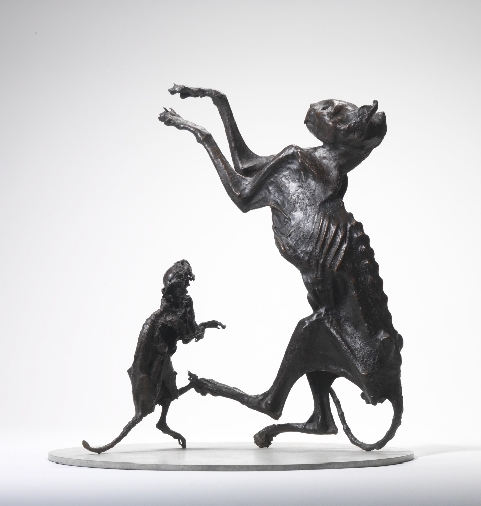
In A complete failure of the electrical impulses which keep the heart beating (2013), Thomas Parkhouse engages in portraiture of a different kind: he has cast in clay objects designed to be worn. The recast garments speak poignantly of the absent wearer. In casting unstable materials such as leather and cloth Parkhouse implicitly draws attention to the ephemerality and fragility of the body that inhabits the garment and that has shaped its folds and creases. Similarly, Steve Dilworth's Dance of Death (2007) casts the dessicated bodies of a rat and a cat, both dead from arsenic poison and grotesquely stood upright, in the smooth and stable materiality of bronze. Cornelia Parker perhaps offers the most radical transformation of material in Bullet Drawing (2009). Here the bullet's determined and lethal trajectory is spun into a delicate filament that is bent into an uneven grid.

For more information check out what the curator and some of the participating artists had to say:


And don't forget to set your compass to East by South East and explore the Old Big School's upcoming exhibition which will feature work by some of the most fascinating and innovative artists from China, Tibet and Japan:  http://www.tonbridge-school.co.uk/about-the-school/our-facilities/obs-gallery/east-by-south-east/

Tuesday, 22 April 2014

Exhibition Spotlight: Beautiful Science: Picturing Data, Inspiring Insight

Natasha Ruiz-Gómez
April 2014

[NASA]
I was mesmerized by the video that greets the visitor to the British Library's current
exhibition, Beautiful Science: Picturing Data, Inspiring Insight. In NASA's Perpetual Ocean (2011),
ocean currents are rendered as spiraling white lines that make and unmake themselves as
they whirl across the surface of this virtual earth. The exhibition makes a powerful argument
for the critical importance of the visual in communicating scientific data and helping
scientists and others (including Florence Nightingale, whose important 'Diagram of the
Causes of Mortality in the Army' during the Crimean War is displayed nearby) to persuade
their audiences. As I stood transfixed, I became aware that I was recalling the waves and
eddies that animate Vincent Van Gogh's Starry Night (1889, New York, Museum of Modern
Art), and I was struck by the unexpected ways that art can illuminate science, and science art.

Exhibition URL: http://www.bl.uk/whatson/exhibitions/beautiful-science


Video URL: https://www.youtube.com/watch?v=CCmTY0PKGDs


Diagram of the Causes of Mortality in the Army in the East Florence Nightingale. Notes on matters, affecting the health, efficiency and hospital administration of the British Army. London, 1858. [BL]

Vincent Van Gogh, The Starry Night (1889) [MOMA]

Thursday, 20 March 2014

Exhibition Spotlight: Georgians Revealed

By Dr Natasha Ruiz-Gómez

A short summary of my favourite exhibition so far in 2014.

Georgians Revealed: Life, Style and the Making of Modern Britain
British Library
Until March 11 2014

"Tasteful and polite, or riotous and pleasure-obsessed? Discover the Georgians as they really were, through the objects that tell the stories of their lives."
 
1. What is your favourite exhibition that you have been to so far this year?
Georgians Revealed at the British Library.

2.Who did you go with?
I went to the exhibition alone.

3. What was your favourite of art, or artist, from the exhibition?
The heeled clogs that protected the delicate shoes worn by posh ladies, so that they wouldn't get soiled on the dirty streets of England!

4. Using one word or phrase, how would you describe the exhibition?
Overwhelming.